My research goal is to build intelligent agents that operate in the real world. Toward this goal, I work on Embodied AI and computer vision: Vision-Language-Action (VLA) models that connect perception and language to physical action, how to make such agents keep working once they are deployed outside controlled settings, and video understanding that lets them reason about how events unfold over time.
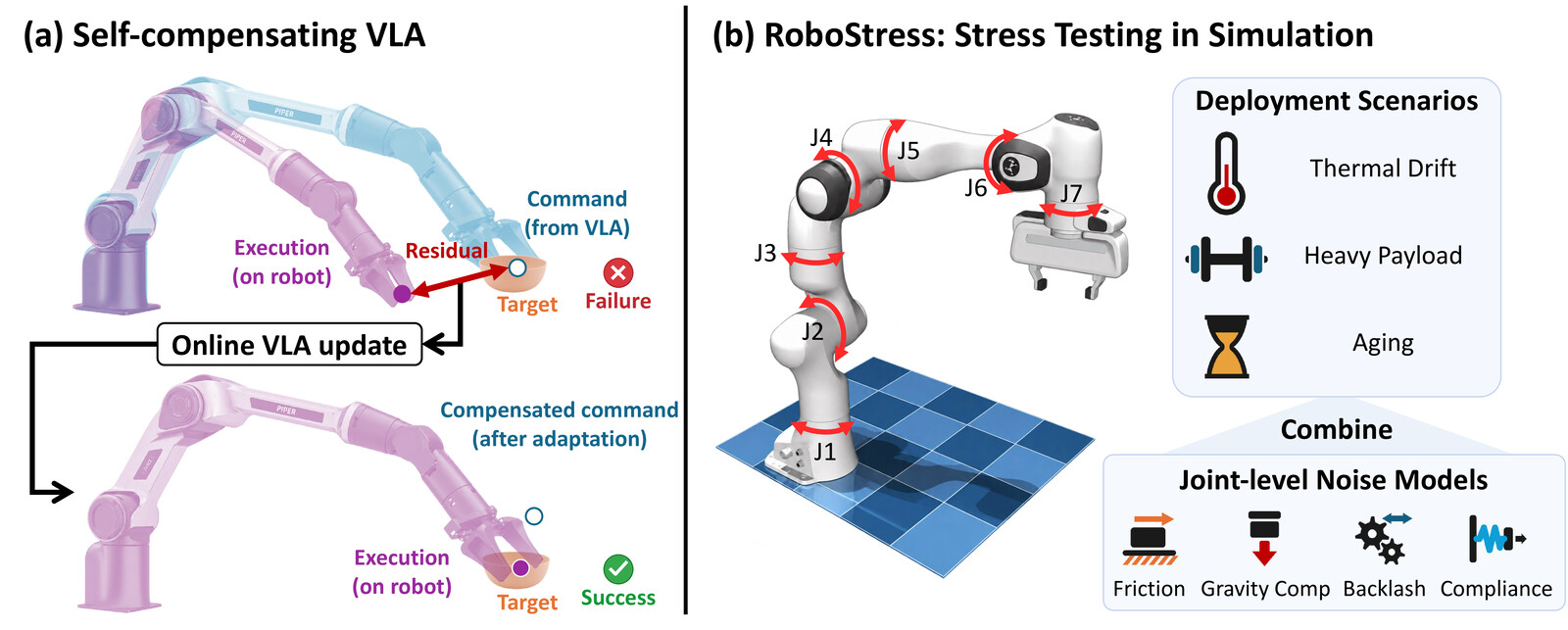
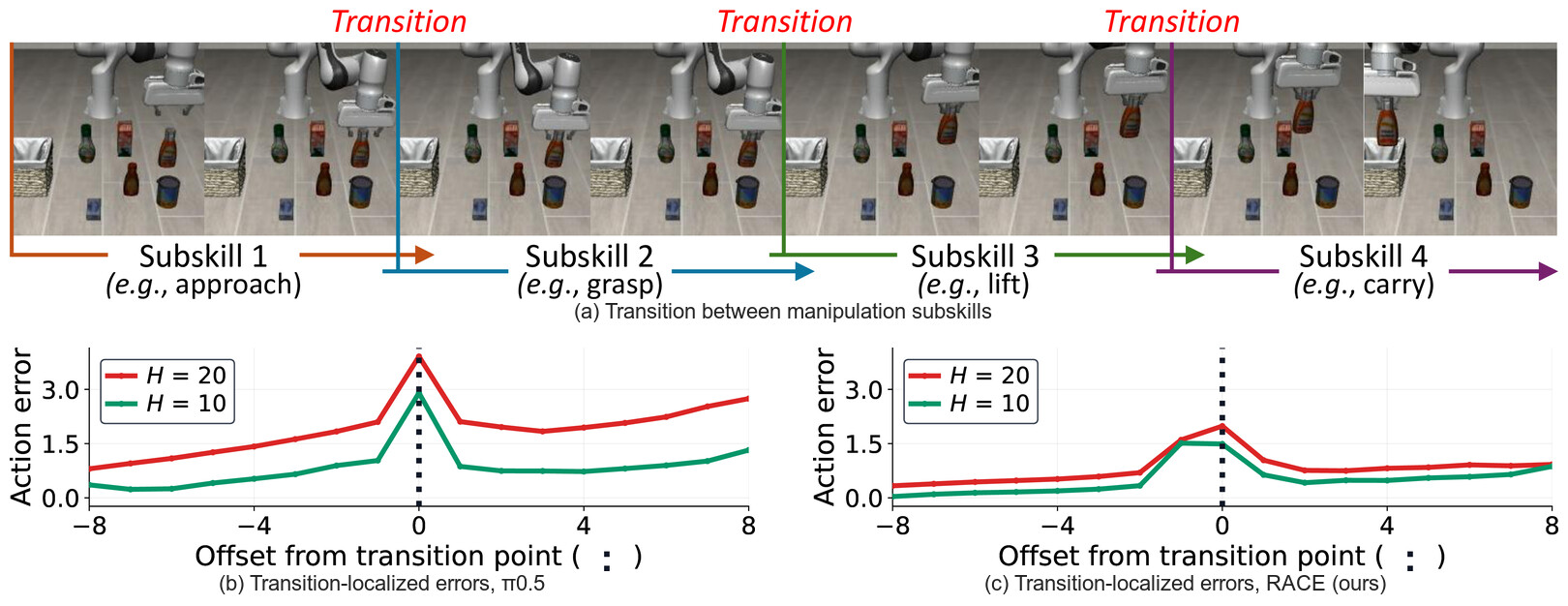
Oct 2026🦾 Two new VLA papers are now on arXiv: Self-Compensating VLA, which adapts online to robot execution errors and comes with the RoboStress benchmark, and RACE, which makes longer action chunks reliable by predicting when to switch subskills.
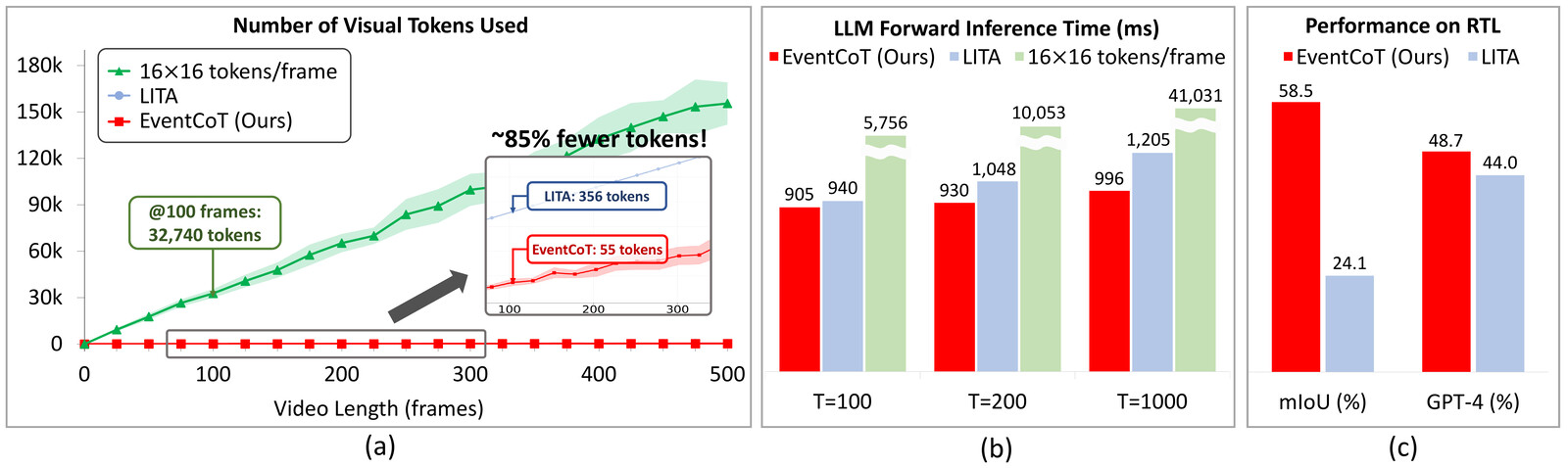
Jul 2026📜 Our paper on reasoning temporal localization, EventCoT, is now available on arXiv.
Feb 2026🏆 Our paper received the Gold Prize at the 38th Workshop of Image Processing and Image Understanding (IPIU 2026), Jeju, South Korea.
04publications
Under Review · 2026
Taming VLAs under Robot Execution Errors: Self-Compensation and Stress Testing
Sohyun Lee*, Yoonjae Baek*, Jaesang Won, Jinnyeong Kim, Hyunwoo Kang, Seung-Hwan Baek, Ivan Laptev, Suha Kwak (*equal contribution)
Vision-language-action (VLA) policies often fail when a robot's executed motion deviates from their commanded action. Such execution errors arise from the robot's mechanics and operating conditions, such as wear and payload changes. We propose self-compensating VLA, a deployment-time adaptation method that enables a VLA policy to pre-compensate for the robot's execution errors when generating commands. Without task rewards or labels, it updates the policy online using the residual between the action commanded by a VLA and the motion executed by the robot. To stress-test VLA robustness across execution conditions that are impractical to cover with physical robots alone, we introduce RoboStress, a controlled simulation benchmark. It combines established joint-level models of friction, backlash, compliance, and gravity-compensation error into seven deployment scenarios whose execution errors depend on the robot's state and motion history. On RoboStress, self-compensating VLA achieves higher average task success than both the base policies and methods that build in robustness during training. On two physical robot arms with different usage histories, it raises the average task success rate by more than 30 percentage points on each arm, and the gains extend to objects not seen in the task demonstrations.
Under Review · 2026
When to Switch: Reliable Action-Chunk Extension for Vision-Language-Action Models
Seonghoon Yu, Dongwon Kim, HyungRok Jung, Yoonjae Baek, Byung-kwan Lee, Suha Kwak, Jeany Son
Vision-Language-Action (VLA) models serve as unified policies for robotic manipulation, yet their expensive inference forces robots to pause between policy calls, resulting in stop-and-go execution that interrupts smooth motion and prolongs task completion. Extending the action chunk reduces policy calls and hence these pauses, but predicting farther into the future makes long-chunk execution unreliable. To understand where this unreliability arises, we analyze action errors within long chunks and find that they concentrate around transitions between manipulation subskills, growing sharply with chunk length. This suggests the importance of transition timing, i.e., when to switch subskills within a chunk. Motivated by this observation, we introduce RACE (Reliable Action-Chunk Extension), a framework that predicts the transition timing from an auxiliary one-step denoising pass and conditions action generation on it. By learning and conditioning on transition timing, RACE reduces errors at subskill transitions and enables reliable execution of longer action chunks. Across simulation benchmarks, RACE outperforms fine-tuning at the same chunk length; with 2x longer chunks, it surpasses recent state-of-the-art and efficient VLAs in success rate, and with 4x longer chunks, it remains competitive. On a real robot, RACE uses 4x longer chunks, which reduces the idle time caused by stop-and-go execution by about 5x, while achieving a higher success rate than fine-tuning with the same chunk length.
arXiv · 2026
EventCoT: Event-centric Video Chain-of-thought for Reasoning Temporal Localization
Youngkil Song, Yoonjae Baek, Dongwon Kim, Inho Kim, Dongkeun Kim, Suha Kwak
Reasoning temporal localization (RTL) requires a model to generate an answer that itself contains the time interval supporting it, so high-level reasoning and precise temporal grounding must be produced jointly in a single response. To tackle this challenging task, we propose the first event-centric video chain-of-thought framework, dubbed EventCoT. EventCoT first performs event-centric tokenization of the input video to convert it into compact event tokens, enabling efficient identification of question-relevant events. It then reasons within the identified events to generate the answer, grounding the time interval via embedding matching that aligns placeholder tokens with visual embeddings. EventCoT achieves state-of-the-art results on ActivityNet-RTL for reasoning temporal localization while using substantially fewer visual tokens than previous work. To verify its general performance, we further evaluate EventCoT on the grounded video question answering benchmark ReXTime, where it attains strong zero-shot results.
Neurocomputing · 2026
Dual Path Semantic Segmentation with Locality Guidance Tokens
Jaeik Kim, Yoonjae Baek, Aecheon Jung, Hongyeob Kim, Soyun Choi, Youngeun Kim, Jaeyoung Do, Sungeun Hong
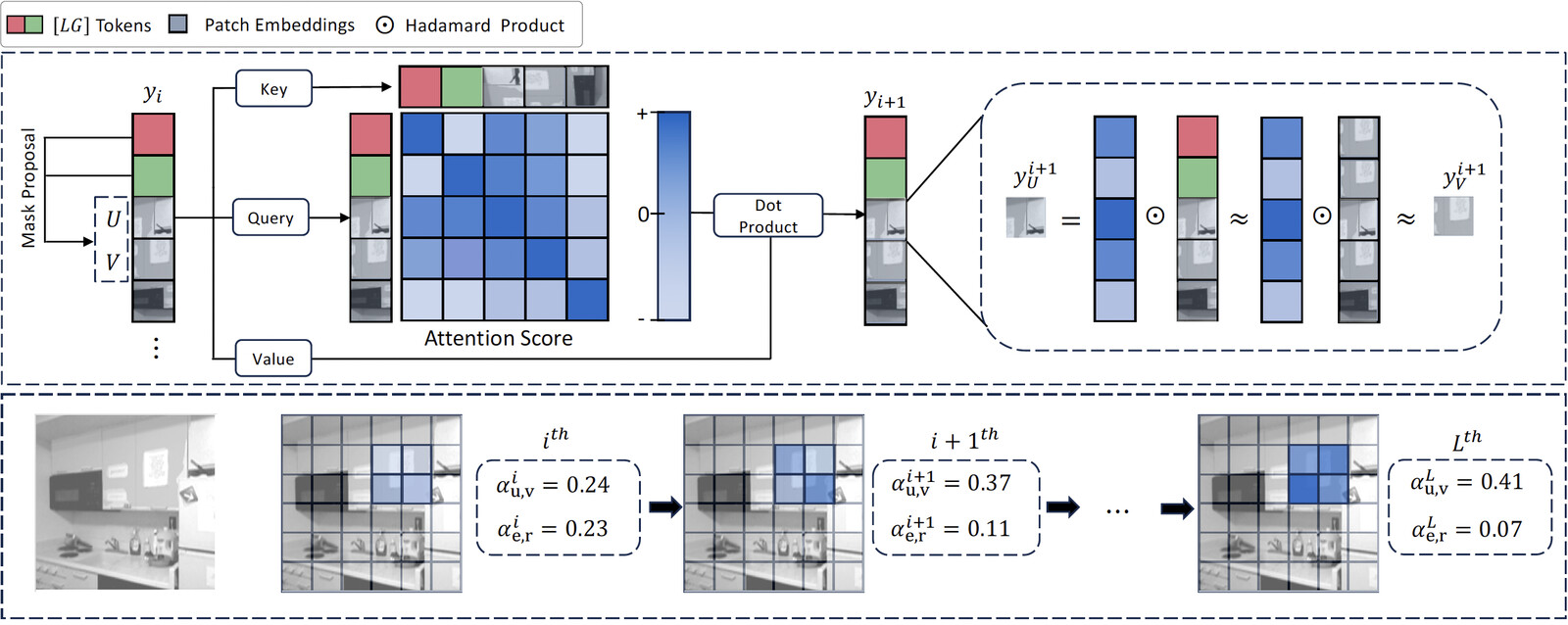
Learnable tokens have shown effectiveness in semantic segmentation by capturing local information, yet most methods rely on late fusion at the decoder, losing fine-grained locality. Our theoretical and empirical analyses reveal that the timing and strategy of token integration significantly influence feature alignment and segmentation accuracy. We propose Dual Path Segmentation (DPSeg), a lightweight and model-agnostic framework that preserves locality throughout encoding and decoding. Our proposed Locality Guidance (LG) tokens play two roles: (i) guiding adjacent patches during encoding to enhance object-consistent attention and fine-grained representations, and (ii) serving as mask proposals in decoding to refine structural consistency. Our path mixing decoder integrates local details with global context without extra data or architectural changes. DPSeg consistently improves performance across various baselines and achieves promising results on various datasets.
05experience
Feb 2025 – PresentResearch and Teaching Assistant, Computer Vision Lab, POSTECH Pohang, South Korea