Publications
2026
- Under Review
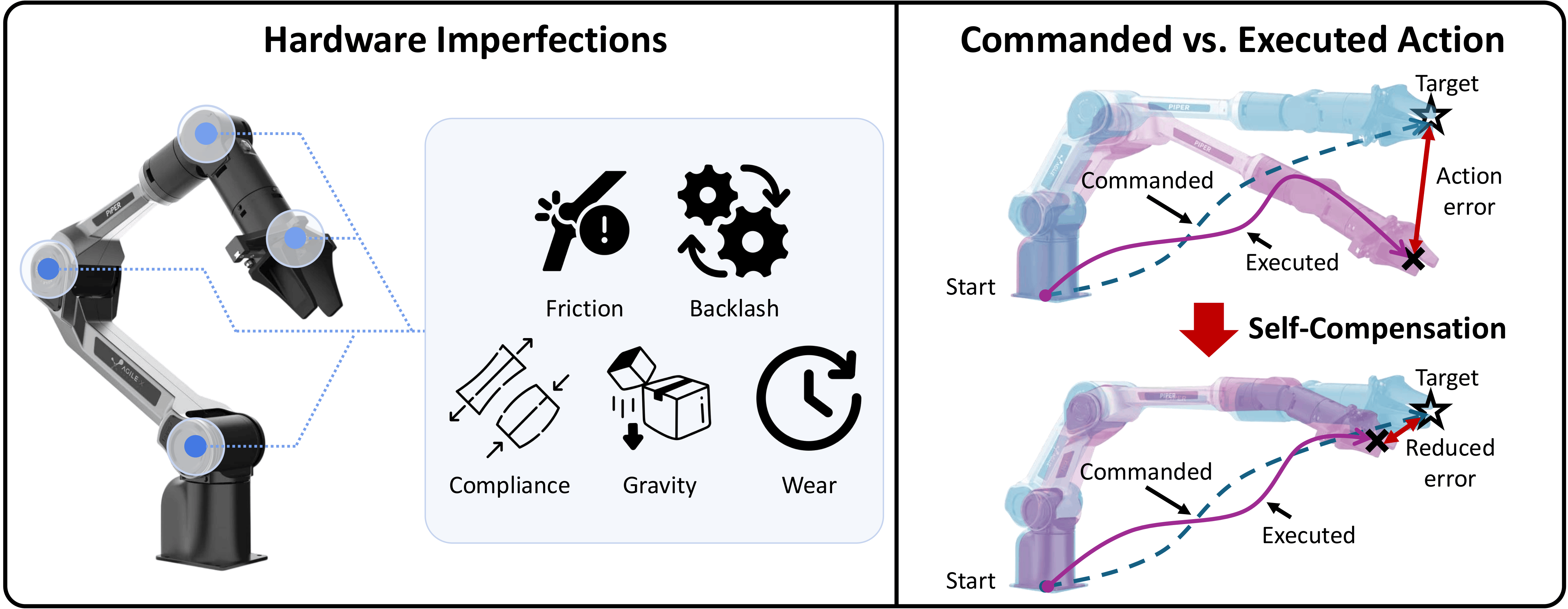 Robustness to Robot Hardware Imperfections: A Benchmark and a Self-Compensating VLASohyun Lee*, Yoonjae Baek*, Jaesang Won, Jinnyeong Kim, Seung-Hwan Baek, Ivan Laptev, and Suha KwakUnder Review, 2026
In this paper, we investigate the robustness of vision-language-action (VLA) models against hardware imperfections. To circumvent the high costs of physical testing, we first introduce a new simulated benchmark, termed Simulated Hardware IMperfections (SHIM), for rigorous evaluation of VLA robustness under precisely controlled hardware imperfections. SHIM models physical hardware realities by incorporating state-dependent, non-Markovian, and joint-level noises, and offers deployment scenarios that combine these noises to approximate real-world composite imperfections. We further present Self-Compensating VLA, a deployment-time adaptation framework that enables a VLA policy to adapt to hardware imperfections on the fly. Our framework adapts online from the residual between its commanded and executed motion, compensating for them without labels. Experiments on SHIM show that our framework broadly improves upon the base policy across diverse settings and successfully adapts to two physical robots with distinct imperfections.
- Preprint
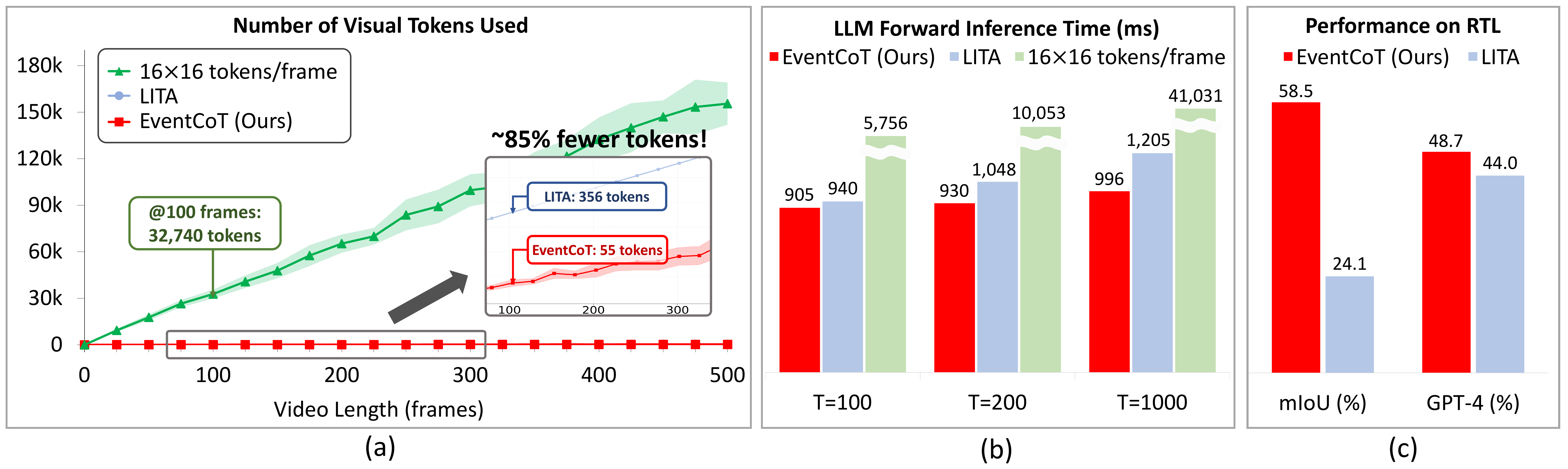 EventCoT: Event-centric Video Chain-of-thought for Reasoning Temporal LocalizationYoungkil Song, Yoonjae Baek, Dongwon Kim, Inho Kim, Dongkeun Kim, and Suha KwakarXiv preprint arXiv:2607.04872, 2026
Reasoning temporal localization (RTL) requires a model to generate an answer that itself contains the time interval supporting it, so high-level reasoning and precise temporal grounding must be produced jointly in a single response. To tackle this challenging task, we propose the first event-centric video chain-of-thought framework, dubbed EventCoT. EventCoT first performs event-centric tokenization of the input video to convert it into compact event tokens, enabling efficient identification of question-relevant events. It then reasons within the identified events to generate the answer, grounding the time interval via embedding matching that aligns placeholder tokens with visual embeddings. EventCoT achieves state-of-the-art results on ActivityNet-RTL for reasoning temporal localization while using substantially fewer visual tokens than previous work. To verify its general performance, we further evaluate EventCoT on the grounded video question answering benchmark ReXTime, where it attains strong zero-shot results.
@article{song2026eventcot, title = {EventCoT: Event-centric Video Chain-of-thought for Reasoning Temporal Localization}, author = {Song, Youngkil and Baek, Yoonjae and Kim, Dongwon and Kim, Inho and Kim, Dongkeun and Kwak, Suha}, journal = {arXiv preprint arXiv:2607.04872}, year = {2026}, } - Neurocomputing
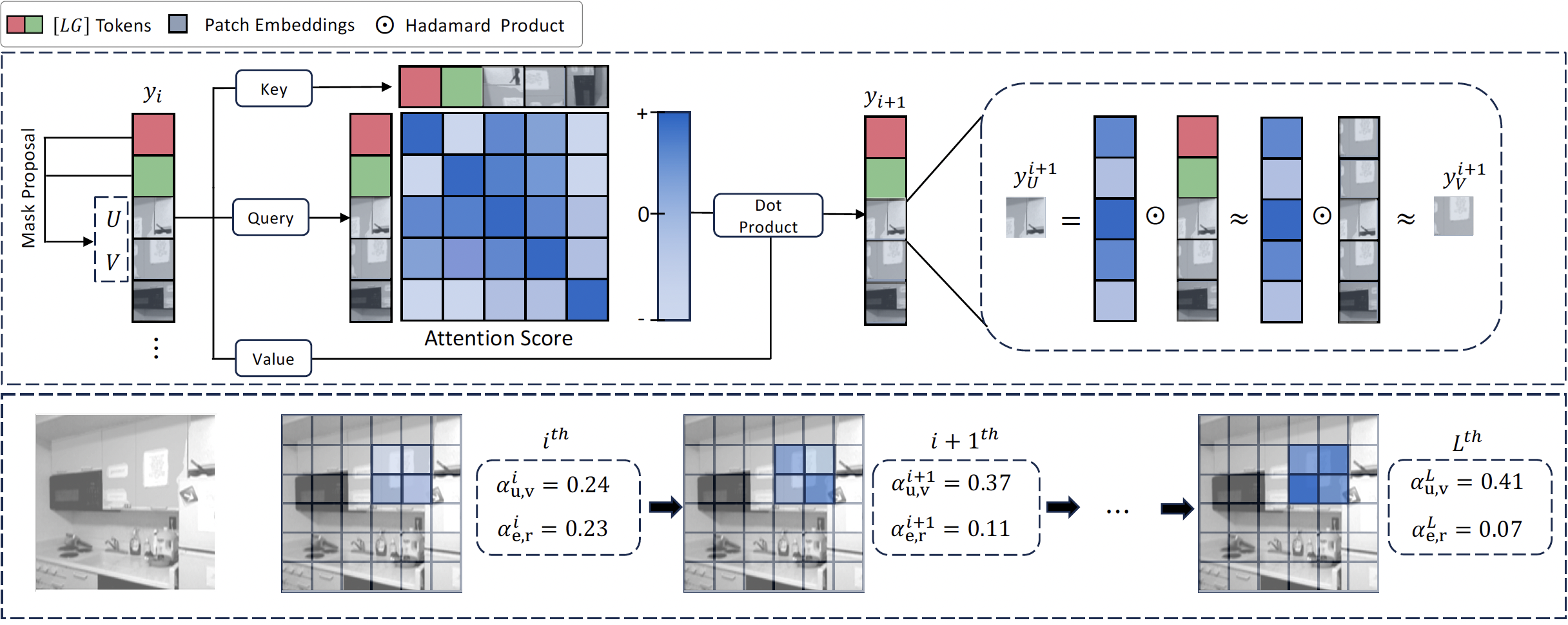 Dual Path Semantic Segmentation with Locality Guidance TokensJaeik Kim, Yoonjae Baek, Aecheon Jung, Hongyeob Kim, Soyun Choi, Youngeun Kim, Jaeyoung Do, and Sungeun HongNeurocomputing (Q1), 2026
Learnable tokens have shown effectiveness in semantic segmentation by capturing local information, yet most methods rely on late fusion at the decoder, losing fine-grained locality. Our theoretical and empirical analyses reveal that the timing and strategy of token integration significantly influence feature alignment and segmentation accuracy. We propose Dual Path Segmentation (DPSeg), a lightweight and model-agnostic framework that preserves locality throughout encoding and decoding. Our proposed Locality Guidance (LG) tokens play two roles: (i) guiding adjacent patches during encoding to enhance object-consistent attention and fine-grained representations, and (ii) serving as mask proposals in decoding to refine structural consistency. Our path mixing decoder integrates local details with global context without extra data or architectural changes. DPSeg consistently improves performance across various baselines and achieves promising results on various datasets.